Duiddo Imani Muhammad, Universitas Gadjah Mada, and a postgraduate student in notarialaw at Universitas Indonesia.
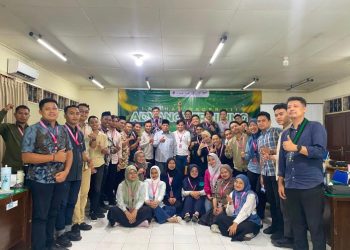
Cakraline.com – Participants of the Advanced Training (LK 3) of HMI East Java Regional Coordinator (Badko Jatim) When Elim Tyu Samba took the podium at a recent seminar on women in politics, the symbolism wrote itself: a30-year old woman, the first female deputy mayor in Blitar’s history, addressing a room about representation while embodying it in real time. But symbolism is inexpensive in Indonesian local politics; nearly every election cycle produces its own “first woman to…” headline.

The harder question is whether her institutional position translates into governance that functions — a question that cannot be answered by reading the regional autonomy statute alone. It has to be read against the social terrain the law is meant to operate in, an approach long associated with the socio-legal tradition in Indonesian legal scholarship: not sociology appended to law as an afterthought, but law understood as inseparable from the society it governs.
Two generations, two grammars of authority Set Elim beside a predecessor like Mundjidah Wahab, who governed Jombang regency from 201 8 to 2023 as its first female regent and carried the inherited moral authority of being a daughter of Nahdlatul.
Ulama co-founder K.H. Abdul Wahab Hasbullah. Mundjidah’s legitimacy was largely genealogical and ceremonial: pesantren lineage, formal remarks at commemorative events, communication routed through structured coordination forums with journalists rather than direct public dialogue. It was, in its idiom, effective — but a one-directional grammar, authority descending from status rather than exchanged through dialogue.
Elim represents a different grammar. Her political capital rests less on lineage than on visibility: an active social media following and a public narrative built on personal history and generational relatability. Formally, both women hold the same office under the same regional government law. But a socio-legal reading insists that how authority communicates is not incidental to governance — it is part of accountability itself.
Indonesia’s Public Information Disclosure Law was written on the premise that citizens are entitled not merely to formal transparency but to comprehensible transparency. A leader who communicates only through ceremony technically satisfies disclosure norms while missing their spirit.
Whether Elim’s more direct communication style closes that gap, or simply trades one kind of distance for another, remains an open empirical question rather than a settled verdict in her favor.
An old problem, read through New Public Management Christopher Hood’s account of New Public Management is useful here, not decorative. His 1 991 taxonomy — hands-on professional management, explicit output standards, disaggregated units, competitive discipline borrowed from the private sector — was written to describe Thatcher-era Britain, but travels surprisingly well to Indonesian municipal water governance.
The wider Blitar area now faces recurring dry-season water emergencies, with localdisaster agencies reporting groundwater depletion and thin contingency budgets. In NPM terms, a deputy mayor’s water strategy is a question of institutional design: is the municipal water utility managed against measurable output targets, or run on input-based bureaucratic routine?
It is tempting to reach for Singapore’s NEWater as the aspirational model. Since 2003, Singapore’s national water agency, PUB, has built reclaimed wastewater into roughly 40 percent of daily demand, with a 55 percent target by 2060 — a genuine feat of engineering and public trust-building that turned a strategic vulnerability into a national achievement. But the comparison, read structurally rather than
aspirationally, shows why Blitar’s problem is not a smaller version of Singapore’s. Singapore’s vulnerability was maritime and diplomatic: an island state historically dependent on piped water from Malaysia, positioned at the convergence of theMalacca and Singapore straits. That coastal position made desalination and reclamation viable, administered by a single undivided authority able to plan a five-decade strategy without another government’s consent.
Kota Blitar has none of these features, and its constraint is jurisdictional before it is technological. The city is a landlocked administrative enclave entirely surrounded by Blitar regency, with no coastline and therefore no desalination pathway even in principle. More consequentially, much of its watershed and groundwater recharge zone liesoutside its own boundary, inside a separate regency government with its own budget and disaster agency.
Where Singapore solved its water sovereignty problem by internalizing supply within one jurisdiction, Blitar’s cannot be engineered away — it can only be negotiated, through intergovernmental cooperation instruments that regional autonomy law permits but does not require. When efficiency logic turns against the citizen A smaller episode from her term illustrates the same structural bind from another angle.
Speaking at the same seminar, Elim recounted pushing back after one of Indonesia’s state-owned Himbara banks began routing certain account-opening processes for Blitar customers through its Kediri branch network rather than servicing them locally — treating the city’s small population base as insufficiently profitable to warrant dedicated capacity.
Read past the headline of a young leader defending her city, the episode captures atension NPM’s own doctrines never resolved: efficiency and cost discipline, pursued far enough, tend toward consolidation, the opposite of accessible local service — even where financial-inclusion regulation formally exists to prevent it. Kota Blitar’s water catchment sits beyond its borders on one side; its banking back-office was, in this account, rerouted through a larger neighbor on the other.
Formal administrative independence keeps colliding with a functional gravity pulling services outward. Representation as method, not milestone Elim’s youth, gender and communicative fluency are genuine assets in an era where public trust increasingly rests on legibility rather than lineage.
But whether Blitar’s residents secure reliable water, or whether national poverty-reduction programs sucas Sekolah Rakyat and the free nutritious meal initiative actually reach the households they target, will be decided by institutional mechanics — budget discipline, intergovernmental coordination, measurable output — that no amount of relatable public communication can substitute for. That, ultimately, is the socio-legal point: the statute and the society it governs are not two subjects to compare, but one object to be read together.
The writer is graduate of the Faculty of Law, Universitas Gadjah Mada, and a postgraduate student in notarialaw at Universitas Indonesia.